PPFD Details
What PPFD level should I keep to feed my cannabis?
PPFD stands for “Photosynthetic Photon Flux Density,” and it’s measured in μmol/m2/s. This measurement is crucial for cultivators because it tells you how much light is available as “food” for photosynthesis. To get more technical, PPFD measures the available Photosynthetic Active Radiation (PAR) at different locations in your grow space. --Quote "RMK"
Unlike other light intensity measures, PAR focuses on photons we can’t see with our physical eyes. Plants like cannabis absorb a wide range of light wavelengths (300-800 nm) to convert water and CO2 into oxygen and carbs. Hence, more refined measures like PAR and PPFD give cultivators a better understanding of how much “photon food” their plants are getting.
Natural sunlight has a PPFD value of around 900 - 2,000 μmol/m2/s throughout the year.
According to multiple studies, Cannabis could absorb a maximum of 2000 μmol/m2/s. For most indoor grow spaces and "photon food", cultivators focus on grow phases regarding nutrients and PPFD levels to keep the plants healthy with quality.
VEG: 400-800 μmol/m2/s, middle is 600 μmol/m2/s, and it's the common PPFD level for most cultivators to feed their cannabis. By binding CO2, using a longer lighting period of 2-4 weeks could help you grow bigger plants and better yields. 800 μmol/m2/s would be a great level for big plants.
Flower: 800-1500 μmol/m2/s, middle is 1150 μmol/m2/s. The flowering phase will require cultivators to balance PPFD levels and nutrients for plants regarding weeks of the flowering period. Supplying CO2 could maximize crop yields, and keep sickness away from your plants, especially boost rooting and grow stronger, bigger buds to achieve your new ROI level.
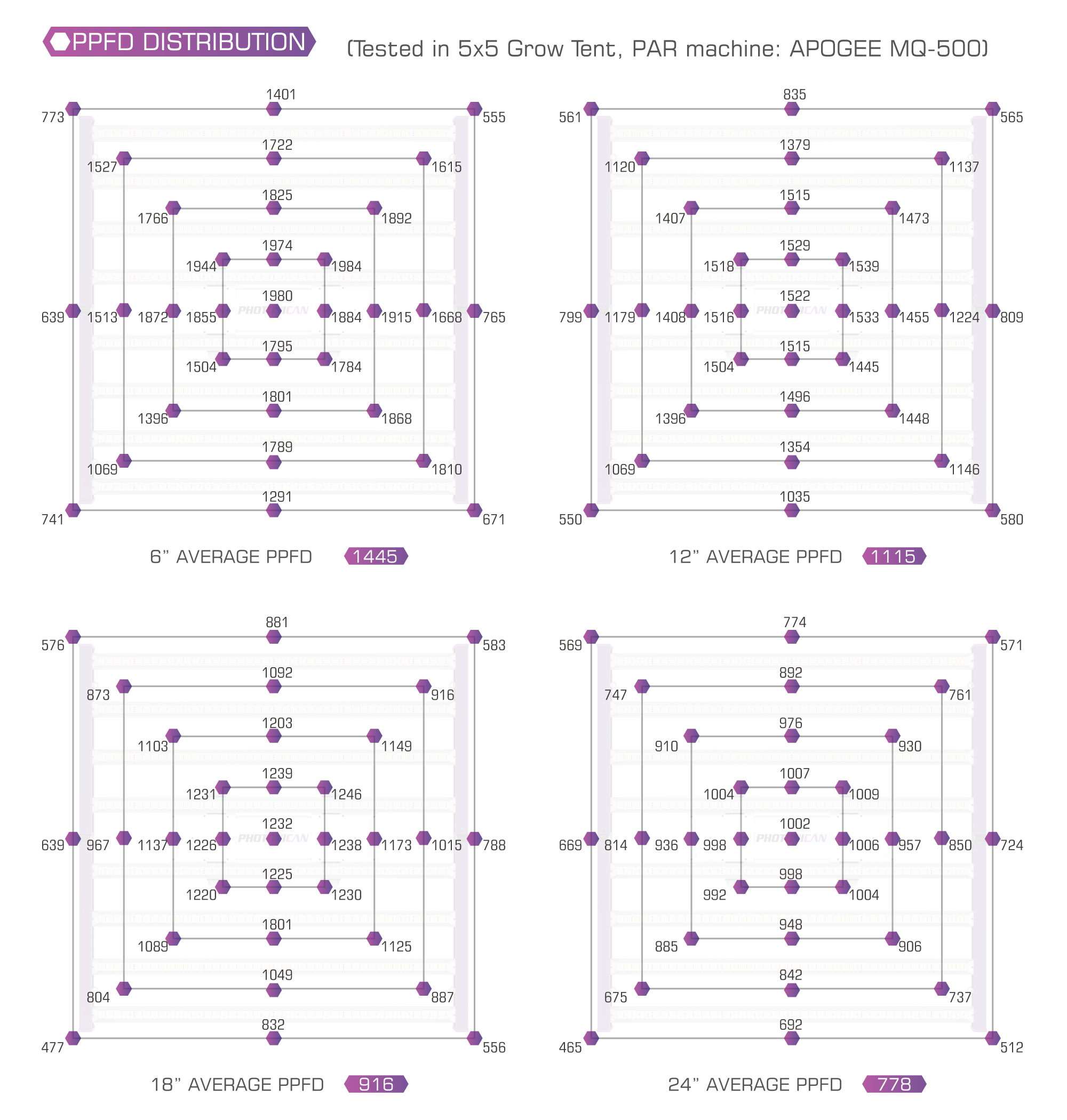
The below measurements can be used for PPFD level targets. All readings were taken in a 5’ x 5’ tent to reduce light reflection that can happen in a 4’x4’ tent (that most manufacturers use). If using multiple lights, true readings will be higher due to light gap supplements.
The PAR test machine is all new, machine model: APOGEE MQ-500.
Test Model: Aurora 2000